Post Disclaimer
Disclaimer:
The information provided on this website is for educational and informational purposes only. I am not an attorney, accredited claims agent, Veterans Service Officer (VSO), or medical professional. Nothing on this site should be taken as legal advice, medical advice, or a substitute for professional guidance. Every veteran’s situation is unique, and you should consult with a qualified VSO, accredited representative, attorney, or licensed medical professional for advice regarding your specific claim or condition.
Any references to doctors, attorneys, or other professionals are provided for informational purposes only. They are not affiliated with this website, and inclusion does not constitute an endorsement or partnership. Use of this site and its content is at your own discretion.
A VA nexus letter is one of the most powerful pieces of evidence a veteran can submit for a disability claim. It is important to understand that paying for a nexus letter is NOT always the best answer. There are many other options to collect the right evidence. You should always consult with a VSO, accredited agent or attorney before paying for a nexus letter.
However, if you’re trying to prove that your current medical condition is connected to your military service and you have been denied or you are trying to connect a complex secondary condition a nexus letter could be the answer.
But many veterans ask the same question: Who is qualified to write a nexus letter?
In this article, we’ll explain exactly who is qualified to write a nexus letter, what credentials matter most, and what makes a strong medical opinion for VA disability claims.
Who Is Qualified to Complete a Nexus Letter?
According to 38 CFR 3.159, “Competent medical evidence means evidence provided by a person who is qualified through education, training, or experience to offer medical diagnoses, statements, or opinions. Competent medical evidence may also mean statements conveying sound medical principles found in medical treatises. It would also include statements contained in authoritative writings such as medical and scientific articles and research reports or analyses.”
This means medical evidence is competent if it is completed by a someone who has completed education, training and/or experience that qualifies them to offer a medical diagnosis. This all applies to nexus letters as well. A nexus letter must be completed by a licensed medical professional who is qualified to evaluate your medical condition and provide an expert opinion.
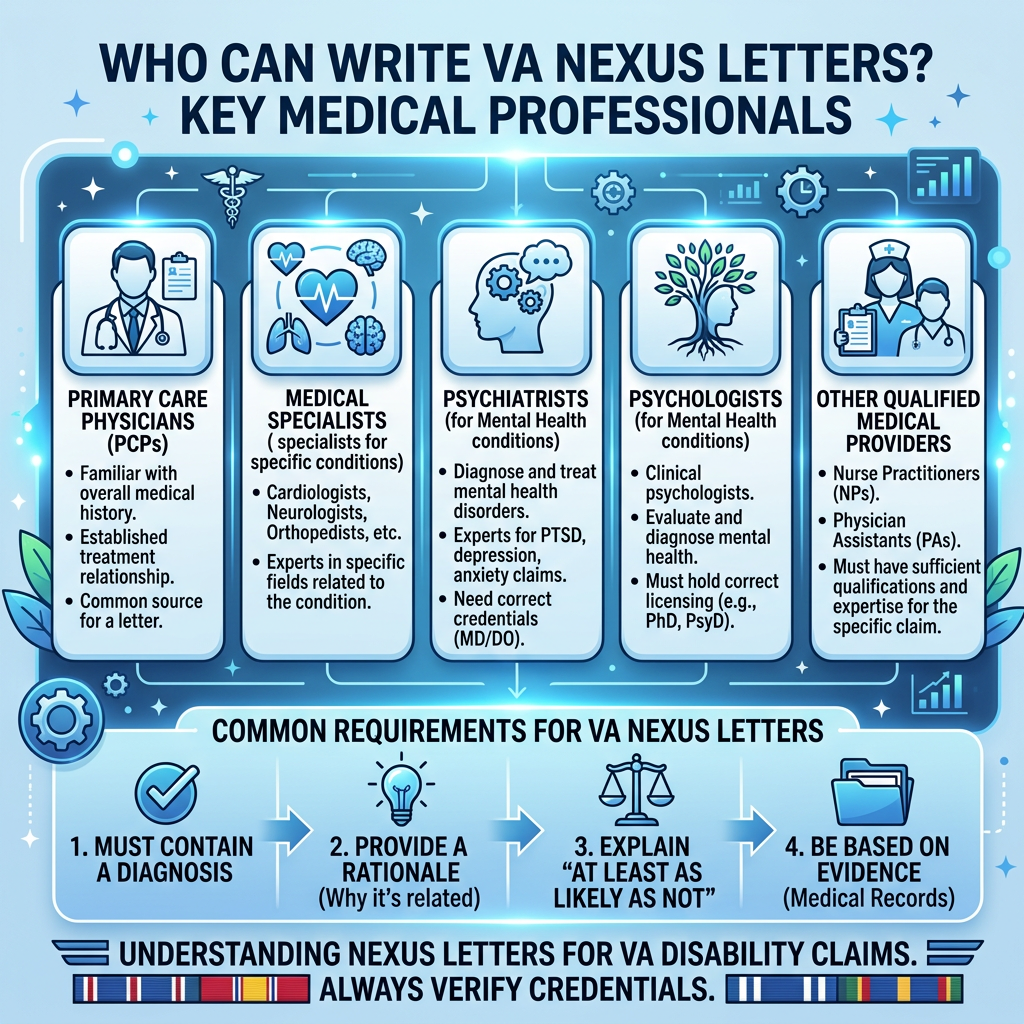
Common providers who can complete nexus letters include, but are not limited to:
- Medical doctors (MD)
- Doctors of Osteopathic Medicine (DO)
- Psychiatrists and psychologists (for mental health claims)
- Nurse practitioners (NP)
- Physician assistants (PA)
- Specialists such as neurologists, orthopedists, or cardiologists
The most important requirement is that the provider is properly licensed and medically qualified to assess your specific condition. The VA may give more weight to opinions from specialists who routinely treat the condition being claimed.
Check out our Nexus Letter Directory
The medical professionals listed in this directory are not affiliated with informedveteran.com. Please do your own due diligence before paying for a nexus letter.
Can a VA Doctor Write a Nexus Letter?
Yes, a VA doctor can complete a nexus letter, but in practice, many VA providers are reluctant to write them. This is not because they are prohibited, but because VA facilities often avoid writing legal-style medical opinions for disability claims.
Because of this, many veterans seek nexus letters from private medical providers who understand VA disability standards and are willing to document the service connection clearly.
Keep in mind, you personal doctor might be able to help you with a nexus letter or statement – which could be FREE!
What Makes a Nexus Letter Valid?
A nexus letter is not just a note from a doctor. It should include specific elements to be considered credible and useful by the VA:
- The provider’s full name, credentials, and license information
- A clear medical diagnosis
- A review of relevant service records and medical history
- Medical reasoning that connects the current disability to military service
- A legally strong phrase such as “at least as likely as not” (50% or greater probability)
A simple statement like “this condition may be related to service” is usually not strong enough to support a claim.
Does the Doctor Need to Review Military and Service Treatment Records?
Yes, and this is one of the most important parts of a credible nexus letter.
The medical professional should review:
- Service treatment records (if available)
- VA medical records
- Private medical records
- Relevant medical studies or literature
- Anything that might support the theory
When the provider states in the letter that they reviewed your records, the VA may give the opinion more weight.
Should You Use a Specialist for a Nexus Letter?
If possible, yes. But it’s not necessary. Anyone qualified that understands your condition will work.
While general practitioners can write nexus letters, the VA may give more probative value to opinions from specialists. For example:
- An orthopedist for knee, back, or joint claims
- A neurologist for migraines or nerve conditions
- A psychiatrist or psychologist for PTSD, anxiety, or depression
This helps strengthen the credibility of your evidence and improves your chances of approval.
Can Veterans Write Their Own Nexus Letters?
Veterans can submit personal statements and “lay evidence,” but you cannot self-complete a nexus letter. A nexus letter is considered a medical opinion, and only licensed medical providers can logically give that type of evidence.
Your personal statement can support the claim, but it cannot replace a medical nexus opinion.
Final Answer: Who Completes a Nexus Letter?
A VA nexus letter is completed by a licensed medical professional who is qualified to evaluate your condition and provide a medically sound opinion linking your disability to your military service.
While VA doctors can technically write them, most veterans obtain nexus letters from private physicians or medical specialists who understand VA disability standards. The strongest letters include a clear medical rationale, records review, and the key phrase “at least as likely as not.”
Post Disclaimer
Disclaimer:
The information provided on this website is for educational and informational purposes only. I am not an attorney, accredited claims agent, Veterans Service Officer (VSO), or medical professional. Nothing on this site should be taken as legal advice, medical advice, or a substitute for professional guidance. Every veteran’s situation is unique, and you should consult with a qualified VSO, accredited representative, attorney, or licensed medical professional for advice regarding your specific claim or condition.
Any references to doctors, attorneys, or other professionals are provided for informational purposes only. They are not affiliated with this website, and inclusion does not constitute an endorsement or partnership. Use of this site and its content is at your own discretion.