Post Disclaimer
Disclaimer:
The information provided on this website is for educational and informational purposes only. I am not an attorney, accredited claims agent, Veterans Service Officer (VSO), or medical professional. Nothing on this site should be taken as legal advice, medical advice, or a substitute for professional guidance. Every veteran’s situation is unique, and you should consult with a qualified VSO, accredited representative, attorney, or licensed medical professional for advice regarding your specific claim or condition.
Any references to doctors, attorneys, or other professionals are provided for informational purposes only. They are not affiliated with this website, and inclusion does not constitute an endorsement or partnership. Use of this site and its content is at your own discretion.
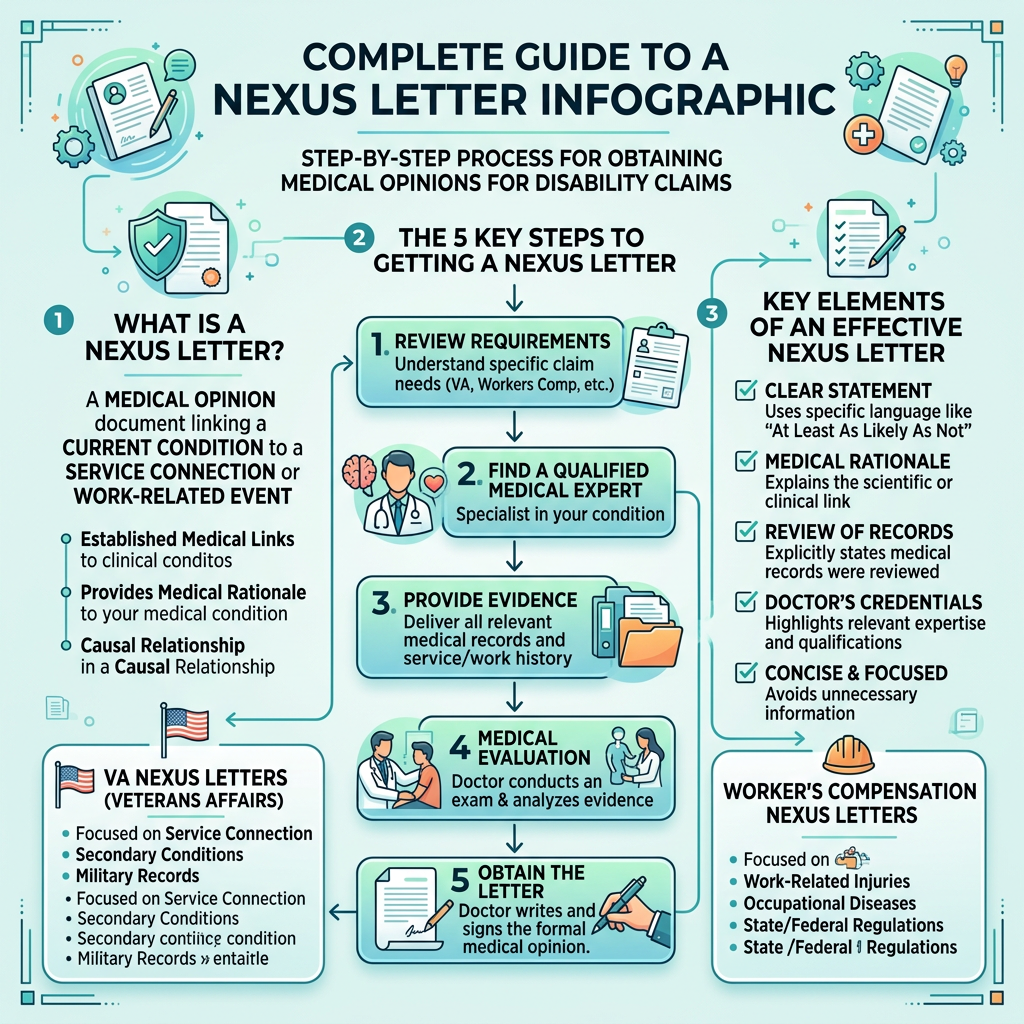
A VA nexus letter is a written medical opinion from a qualified healthcare professional explaining whether a veteran’s current medical condition is connected to military service or to an already service-connected disability.
For many veterans, establishing this connection is one of the most challenging parts of a VA disability claim.
But here’s something important to understand:
You don’t always need to pay for a nexus letter. In fact, you may not need a separate nexus letter at all.
Depending on your claim, the necessary medical evidence may already be in your treatment records, or the VA may obtain a medical opinion through the Compensation and Pension (C&P) examination process.
In this guide, we’ll cover what a nexus letter is, when it may be useful, who can write one, what makes a strong medical opinion, and how to obtain one without unnecessarily spending money.
We’ll also look at a fictional VA nexus letter example to illustrate what a well-supported medical opinion might contain.
What Is a Nexus Letter for VA Disability?
A nexus letter is a medical opinion that helps establish a connection between a veteran’s disability and military service.
For a typical direct service connection claim, the VA generally looks for three elements:
- A current disability: Evidence showing that you have a current medical condition.
- An in-service event, injury, or disease: Evidence of something that occurred during military service.
- A nexus: Evidence connecting the current disability to the in-service event, injury, or disease.
A nexus letter primarily addresses the third element.
Example: A Veteran With Back Pain
Imagine a veteran who injured their back while lifting heavy equipment during military service.
The veteran visited sick call, received treatment, and continued serving.
Years later, the veteran has a diagnosed lumbar spine condition and files a VA disability claim.
The veteran has medical evidence of a current condition and documentation of an in-service back injury.
However, the VA must still determine whether the current condition is related to that earlier injury.
A qualified medical professional may provide an opinion explaining whether the two are medically connected.
The important part isn’t simply stating that the conditions are connected. The clinician should explain the medical reasoning supporting that conclusion.
Do You Really Need a Nexus Letter?
Not every VA disability claim requires a separately purchased or privately obtained nexus letter.
Before spending hundreds or thousands of dollars, consider what evidence already exists.
1. Your medical records may already establish the connection
Sometimes medical treatment records contain relevant diagnoses, clinical findings, and opinions explaining the relationship between a current disability and military service.
A separate letter may not add much if the necessary evidence is already present.
2. A VA C&P examiner may provide the medical opinion
The VA may schedule a C&P examination or request a medical opinion when it needs additional evidence to decide a claim.
That examiner may address whether the claimed condition is connected to service.
However, an examination does not guarantee a favorable opinion.
3. Your condition may qualify for presumptive service connection
Certain medical conditions may qualify for presumptive service connection based on qualifying military service, exposures, or other eligibility requirements.
For eligible claims, the VA may presume the relationship to service without requiring an individualized medical nexus opinion.
Free resource: Use the VA Presumptive Condition Checker to explore conditions that may be associated with your military service.
4. Your claim may benefit from an independent medical opinion
A separate nexus letter may be particularly useful when:
- Your service treatment records are incomplete or do not clearly establish the medical connection.
- Your symptoms developed years after leaving the military.
- You are claiming a condition secondary to an existing service-connected disability.
- The VA previously denied your claim because the evidence did not establish a connection.
- A negative C&P medical opinion needs to be addressed with additional medical evidence.
The decision should depend on the specific evidence in your claim—not the assumption that every veteran must purchase a nexus letter.
Who Can Write a VA Nexus Letter?
A nexus letter should come from a healthcare professional qualified to provide an opinion about the medical condition and the relationship being evaluated.
Depending on the medical issue, that professional might be:
- A medical doctor (MD) or doctor of osteopathic medicine (DO)
- A nurse practitioner
- A physician assistant
- A psychologist or psychiatrist
- A relevant medical specialist, such as an orthopedic physician, neurologist, or pulmonologist
The professional’s qualifications should match the medical question being addressed.
For example, a neurologist may be particularly qualified to evaluate certain neurological conditions, while an orthopedic specialist may be well suited to evaluating musculoskeletal injuries.
Can Your Own Doctor Write a Nexus Letter?
Yes. Your personal physician may be able to provide a nexus letter if they are qualified, willing, and able to form an independent medical opinion.
A treating physician may already be familiar with your medical history, symptoms, treatment, and diagnostic testing.
That familiarity can be helpful, although a treating relationship alone does not automatically make an opinion more persuasive.
I was able to obtain a nexus letter from my own doctor without paying a private nexus letter company.
Read my experience: How I Got a Free Nexus Letter From My Personal Doctor
What Should a Strong VA Nexus Letter Include?
A strong nexus letter is more than a statement saying a disability is related to military service.
The most persuasive opinions generally explain the medical basis for the conclusion.
Here are five important components.
1. The medical professional’s credentials
The letter should identify the healthcare professional, their relevant qualifications, and the medical field in which they practice.
2. The veteran’s medical history and records reviewed
The professional should identify the information considered when developing the opinion.
Depending on the claim, this may include:
- Service treatment records
- Military personnel records
- VA and private medical records
- Diagnostic imaging and laboratory results
- Relevant C&P examination findings
- The veteran’s reported symptoms and medical history
A clinician should accurately identify what was reviewed rather than claim to have reviewed records that were unavailable.
3. A clear medical conclusion
A favorable opinion may use language such as:
“It is at least as likely as not that the veteran’s current condition is related to the documented in-service injury.”
This phrase generally communicates that the evidence supports a probability of at least approximately 50%.
However, a medical opinion is not automatically inadequate simply because it uses different wording. Its meaning, supporting reasoning, and the entire evidentiary record matter.
4. A detailed medical rationale
This is one of the most important components.
The clinician should explain why the available medical evidence supports the conclusion.
Depending on the condition, this could involve:
- The nature of the original injury
- The veteran’s symptoms and treatment history
- Diagnostic findings
- The medical relationship between the injury and current condition
- Relevant medical research
- Other possible causes or contributing factors
A conclusion without a meaningful explanation may carry less evidentiary weight than a well-reasoned medical opinion.
5. Signature and identifying information
The opinion should identify its author and preferably include a signature, date, professional credentials, and contact information.
VA Nexus Letter Example
The following fictional example illustrates how a medical professional might organize a nexus opinion.
Important: This is an educational example, not a completed medical opinion or a guarantee of VA acceptance. A licensed professional must independently evaluate the actual veteran’s history, records, and medical evidence before reaching a conclusion.
Sample Nexus Letter — Lumbar Spine Condition
Patient: John Doe (fictional veteran)
Medical condition: Lumbar degenerative disc disease
Purpose: Medical opinion concerning a possible relationship between a current lumbar spine condition and an in-service back injury.
Medical records reviewed
For this example, assume the clinician reviewed the veteran’s service treatment records documenting a lumbar strain during military service, post-service treatment records, lumbar spine imaging, and the veteran’s reported history of symptoms.
Medical opinion
Based on the medical history, available records, diagnostic findings, and my professional evaluation, it is my opinion that the veteran’s current lumbar spine condition is at least as likely as not related to the documented injury sustained during military service.
Medical rationale — illustrative only
The veteran’s service treatment records document a back injury associated with lifting heavy equipment. Subsequent medical records and the veteran’s reported history describe continuing episodes of lumbar pain, with later diagnostic imaging identifying degenerative changes.
In an actual evaluation, I would assess the mechanism of the original injury, the clinical course following service, the imaging findings, relevant medical literature, and alternative explanations such as aging or subsequent injuries.
A favorable nexus conclusion would require an explanation of why the documented evidence supports a service-related cause in this particular veteran, rather than relying on the existence of a past injury and current diagnosis alone.
Clinician: [Name and professional credentials]
Signature and date: [Completed by evaluating clinician]
This example shows the structure of a medical opinion. The illustrative rationale is deliberately not presented as a completed, case-specific medical determination.
A real nexus letter should contain the clinician’s own analysis and actual findings.
How to Get a Nexus Letter From Your Doctor
Before contacting a private nexus letter service, consider discussing the issue with a healthcare professional who already treats you.
Step 1: Gather your relevant medical records
Organize the evidence that could help your clinician understand your condition and military history.
This might include service treatment records, diagnostic tests, medical records, and a timeline of relevant symptoms.
Step 2: Explain what you’re requesting
Ask whether the clinician would be willing to review your records and provide an independent medical opinion concerning the possible relationship between your condition and military service.
Make it clear that you’re requesting their professional assessment—not asking them to guarantee a favorable conclusion.
Step 3: Explain the importance of medical reasoning
A useful opinion should explain the clinical evidence and reasoning supporting the conclusion.
The doctor does not need to become an expert in every VA regulation, but understanding the medical question being asked can help.
Step 4: Ask about fees
Some healthcare professionals may provide an opinion without an additional charge, particularly when they already know the patient and relevant history.
Others may charge for the time needed to review records and prepare a report.
Not every doctor is willing or able to provide this service.
Where to Find Doctors Who Write Nexus Letters
If your personal doctor cannot provide an opinion, you may decide to research independent healthcare professionals who offer medical opinion services.
Before hiring someone, consider asking:
- Is the provider licensed and appropriately qualified?
- Do they have experience evaluating your particular medical condition?
- Will they review your relevant records?
- Will they explain the medical reasoning supporting their conclusion?
- What is included in the quoted fee?
- What happens if the evidence does not support a favorable opinion?
Be cautious of anyone who guarantees a favorable medical opinion or a particular VA disability rating.
Free resource: Find Doctors Who Write Nexus Letters — Informed Veteran Directory
The directory is an informational resource. Listings are not VA or endorsements from Informedveteran.com, and veterans should independently verify qualifications, services, and fees.
How Much Does a Nexus Letter Cost?
Nexus letter costs vary depending on the healthcare professional, the complexity of the medical issue, and the amount of records requiring review.
Some treating professionals may provide opinions without a separate fee.
Independent medical opinion services may charge hundreds or thousands of dollars.
A higher price does not guarantee a stronger opinion or a favorable VA decision.
Before paying, consider whether the medical evidence already in your claim adequately addresses the connection to service.
Can a Nexus Letter Help With a Secondary VA Disability Claim?
Yes. A medical nexus opinion may be useful when a veteran claims that a new disability was caused or aggravated by an existing service-connected disability.
For example, a veteran with a service-connected knee condition might develop a separate condition and believe it resulted from altered walking mechanics.
A medical professional would need to evaluate whether the evidence supports that relationship.
For secondary service connection, medical opinions may address both causation and aggravation, where applicable.
Related resource: VA Secondary Conditions: Complete List of Conditions That May Qualify
Frequently Asked Questions About VA Nexus Letters
Is a nexus letter required for every VA disability claim?
No. VA claims require appropriate evidence supporting service connection, but a separate private nexus letter is not mandatory in every case. Existing medical evidence, VA medical opinions, or applicable presumptions may establish the necessary relationship.
Can a VA doctor write a nexus letter?
A VA healthcare professional may be able to provide relevant medical information or opinions, depending on the circumstances and applicable policies. However, an individual provider may decline a request for a separate letter. Veterans should not assume that every VA clinician will prepare one.
Can a nurse practitioner write a nexus letter?
Yes, a qualified nurse practitioner may provide a medical opinion within their professional competence and scope of practice. The opinion’s persuasive value depends on qualifications, evidence, and reasoning.
Can you get a nexus letter for free?
Possibly. Some treating healthcare professionals may provide an opinion without a separate charge. You may also have sufficient medical evidence already in your records, or VA may obtain a medical opinion as part of its claim-development process.
Does a nexus letter guarantee VA approval?
No. The VA considers the nexus opinion alongside the other evidence in the claim. Even a favorable opinion does not guarantee service connection or a particular disability rating.
Can a nexus letter help after a VA claim denial?
Yes, particularly when the previous denial involved insufficient medical evidence connecting the claimed disability to service. The appropriate next step depends on the decision, available evidence, and the review option selected.
Learn About VA Claim Appeals and Decision Reviews
Is a nexus letter the same as a C&P examination?
No. A nexus letter is a medical opinion, while a C&P examination is an examination or evaluation used in the VA claims process. A C&P examiner may provide a nexus opinion as part of that process.
Final Thoughts: Don’t Pay for a Nexus Letter Until You Understand Your Evidence
A nexus letter can be valuable when a VA disability claim needs additional medical evidence establishing a connection to military service or another service-connected disability.
But veterans should understand the evidence they already have before purchasing an independent medical opinion.
Start by reviewing the three major elements of service connection: a current disability, an in-service event or qualifying basis for service connection, and a connection between the two.
Then determine whether a separate medical opinion could meaningfully strengthen your claim.
Free Informed Veteran Resources
Find a Nexus Letter Doctor: Browse the Free Nexus Letter Directory.
Brainstorm Potential VA Claims: Use the Free VA Disability Brainstorm Worksheet to organize conditions and possible supporting evidence.
Calculate Your Combined Rating: Try the Free VA Disability Rating Calculator.
Explore Presumptive Conditions: Use the Free VA Presumptive Condition Checker.
Organize Your Claim Research: Explore the VA Claims Strategy Dashboard.
Educational Disclaimer
Informed Veteran provides educational information based on research and experience. It does not provide medical advice, legal advice, or individualized VA claims representation. The website is not affiliated with or endorsed by the Department of Veterans Affairs.
Every claim is different. Veterans seeking personalized assistance should consult an appropriately qualified medical professional or VA-accredited representative.
Before you Pay for a Nexus Letter…
These free resources can help you decide whether you need a private nexus letter and how to prepare before spending money.
I got a FREE Nexus Letter from my Personal Doctor (Find out how I did it)
Do you even NEED a Nexus Letter? (Don’t pay for one yet!)
How Much Should a Nexus Letter Cost?
Who Can Write a Nexus Letter?
Post Disclaimer
Disclaimer:
The information provided on this website is for educational and informational purposes only. I am not an attorney, accredited claims agent, Veterans Service Officer (VSO), or medical professional. Nothing on this site should be taken as legal advice, medical advice, or a substitute for professional guidance. Every veteran’s situation is unique, and you should consult with a qualified VSO, accredited representative, attorney, or licensed medical professional for advice regarding your specific claim or condition.
Any references to doctors, attorneys, or other professionals are provided for informational purposes only. They are not affiliated with this website, and inclusion does not constitute an endorsement or partnership. Use of this site and its content is at your own discretion.